
The Distribution Gap: Why Europe's Cyber Boom May Not Build European Champions
Europe's Cyber Founders Are Betting on Regulation. The Ones That Win Will Bet on Distribution Instead.

Written by: Ilya Vencjuns | Research Contributor, London Venture Capital Network
Europe is about to spend a lot more money on cybersecurity. New regulation is bringing more companies into the scope of formal security requirements, while AI is making the threat landscape harder to manage. On paper, that looks like a strong environment for Europe's cybersecurity startups.
But regulation alone will not determine where that money goes. Large organisations tend to buy security from companies they already know, particularly when the purchase is tied to regulatory risk. For European founders, the difficult part may be getting their technology in front of those buyers and giving them enough confidence to sign a contract.
That makes distribution one of the central questions for the next generation of European cybersecurity companies.
The Countdown That Has Founders Excited
Three pieces of European legislation are landing in close succession, and together they are making cybersecurity harder for boards to put off. NIS2 came into force in October 2024, widening the range of companies required to manage and report on cyber risk. DORA followed in January 2025, targeting the financial sector and its operational resilience. The Cyber Resilience Act arrives in 2027, extending security requirements into connected products.
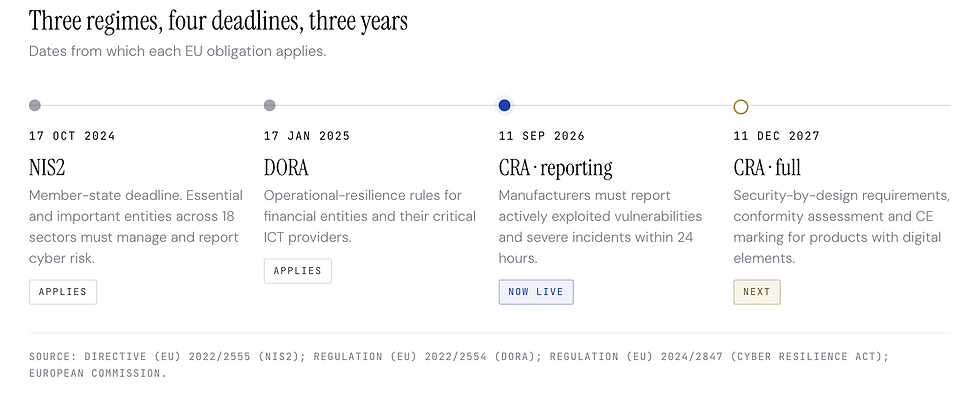
For founders, the timeline is easy to read as a growing market. More companies will need to comply, budgets should follow, and a new generation of agentic AI tools promises to automate some of the manual work that compliance has traditionally required.
The calendar makes the opportunity look straightforward. The spending patterns are more complicated.
Why the Money Flows to the Incumbents
Compliance spending tends to favour vendors that companies already trust. When an enterprise is spending money to satisfy a regulator, the buyer is taking on the risk of getting the decision wrong. The cleverest workflow is not always the easiest one to approve. A familiar vendor with an established reputation is often easier to defend internally.
That helps explain why the established giants are likely to capture much of the spending created by NIS2, DORA and the Cyber Resilience Act. Palo Alto Networks, Check Point and CrowdStrike already have relationships with the organisations now facing these requirements. Their advantage is not just their technology. Their names are familiar to the people making the purchase.
Europe already has a scale problem in cybersecurity. Globally, there are roughly seventy-five cybersecurity unicorns worth a combined two hundred and thirty billion dollars. The UK and Europe account for fewer than ten of them. That is a striking gap for a region with a large pool of technical talent and strong academic research. The UK has the largest cybersecurity talent pool in Europe, while Cork, a city of roughly 140,000 people, is home to the European headquarters of seven of the world's largest cybersecurity companies.
The problem sits further down the chain. Building a strong security product is one thing. Getting enough customers to trust it is another.
The Playbook That Works: Borrow the Distribution You Cannot Build
Cybersecurity founders know what enterprise sales can involve. Procurement takes time. Security questionnaires pile up. Integrations have to be managed. A startup can spend months trying to land a single large account, all while a much larger competitor already has a contract, a relationship and a familiar name.
For a young company, trying to compete with Palo Alto on those terms is usually a poor use of limited resources.
Working through companies that already have those relationships can be a different proposition. Large consultancies, managed service providers and other security vendors can handle the integration and customer relationship, while the startup supplies the technology.
Huntress offers one of the clearest examples. The American company, founded in 2015 by veterans of US military and intelligence cyber operations, built its business around managed service providers rather than pursuing enterprise accounts directly. It now works with more than 4,300 providers, which together bring its technology to more than 100,000 small and mid-sized businesses.
The event that helped establish the strength of that model was a crisis. When the Kaseya supply chain attack hit managed service providers in 2021, Huntress set up a war room and coordinated the response across the channel. The relationships built during that week became a powerful source of loyalty. Huntress has since moved towards $100 million in annual recurring revenue and a valuation close to $1.5 billion. Its success did not come from out-featureting CrowdStrike. It found a segment that the largest vendors had less incentive to serve and built a distribution model around it.
That lesson matters for European founders because distribution can become an asset in its own right. A startup does not need to manage every customer relationship itself if it can become important to the companies that do.
Israel has followed a similar logic for years. Its strength in cybersecurity is often attributed to its military and intelligence pipeline, and that is part of the story. There is another lesson in the country's concentration on security as a sector. A specialised ecosystem creates a shared understanding of what enterprise buyers need. Founders, investors and employees are often operating in the same networks, making it easier to identify problems worth solving and reach the people experiencing them. Cyberstarts, for example, has built customer research into its process, sending founders to investigate specific enterprise problems before they start building a solution.
Europe has generally taken a broader approach to its startup ecosystem. It has plenty of technical expertise, but less of the concentrated cybersecurity network that can turn that expertise into companies at scale.
Why the Whole Motion Gets Built in America First
There is also a geographic reason this model often works better in the United States.
Cybersecurity distribution depends heavily on trust. When a respected consultancy or managed service provider recommends a young security company, some of its credibility transfers with the recommendation. The startup gets access to customers it would have struggled to reach alone.
The US has a particularly deep network of major technology partners, enterprise buyers and investors willing to back companies through the long process of becoming category leaders. Europe has those networks too, but they are more fragmented across countries and markets.
That helps explain why European companies so often turn towards the US as they grow. Close to 48% of Central and Eastern European scale-ups relocate their headquarters outside their country of origin, usually in search of deeper capital markets and a broader customer base. Wiz, often described as an Israeli success story, is technically headquartered in New York.

The result is a pattern that European founders and investors have become familiar with. Build the technology in Europe, establish the company in the US, win the customers and capital there, then expand back into the European market.
It works for individual companies. It raises a harder question for Europe: if founders need to leave to access the customers, capital and distribution required to scale, how much of the resulting value stays in the ecosystem that produced them?
The Agentic Wave That Makes This More Urgent
The technology is changing at the same time as the regulatory environment.
AI has already altered the threat landscape. AI-supported phishing recently accounted for more than 80% of social engineering activity, reflecting a problem that security teams have dealt with for decades: people remain one of the easiest ways into an organisation.
European startups are building around that shift. Qevlar AI in Paris is developing agentic, automated security operations. Aikido in Belgium is working on AI-driven penetration testing. Inner Works uses elite hackers whose live exploits are fed back into models designed to identify and patch vulnerabilities faster.
There is plenty of room for these companies to challenge established vendors. The distribution problem remains, though.
A startup can have a better product and still lose the customer. If an incumbent already has the relationship, the procurement process and the trust of the security team, the startup has to find a way into that relationship. A channel partner can provide that route.
The Gap Worth Chasing
That leaves a more interesting part of the market beneath the headline regulatory boom.
The biggest enterprises are likely to keep buying from the biggest vendors. Smaller companies face a different problem. Many are now being pulled into the scope of new regulation, but they are too small to receive the attention that the largest security vendors give to major accounts.
That middle of the market could become one of Europe's most important opportunities.
Companies such as Oneleet are targeting it with security-first compliance aimed at businesses that need to meet growing requirements without having the resources of a large enterprise security team. Huntress has already shown in the US that this segment can support a very large cybersecurity business.
European regulation is expanding the number of companies that need this kind of help. The smaller companies are where the large vendors have less incentive to compete. That leaves room for startups that can make compliance affordable and simple enough for a business without a large security team.
For founders, the question is how to reach those companies efficiently. Selling through managed service providers is one route. Partnerships with consultancies are another. There is also a case for designing the product around the channel from the beginning, rather than trying to build that distribution network later.
Europe has the talent to build the technology. It has struggled more with turning that technology into companies with enough reach to compete globally.
That is the contradiction at the heart of the current moment. Europe is introducing regulation partly to strengthen its own cybersecurity industry, while many of the companies best placed to benefit still need American capital, American customers and American distribution networks to reach scale.
The rules are being written in Europe. So are many of the products that will help companies comply with them. The bigger question is whether the ecosystem around those products can give founders enough access to customers and capital to build global companies from here, or whether the most successful ones will continue to leave before they can come back.


